
Isn't it great how blogosphere exists to let you write about things for which you're completely unqualified?
In his book, A New Kind of Science, Stephen Wolfram (creator of mathematica) writes about cellular automata, a way of modeling simple computational processes that can generate very complicated behavior. I came across the book back in college while working on a paper trying to link Chomsky's generative grammar with complexity theory (totally hot, I know). The reason I mention it now is that it actually had a section on free will that always stuck with me.
Wolfram claimed that our perception of free will is actually the result of something called Computational Irreducibility, the basic idea of which is that the sum is greater than its parts. When philosophers and scientists talk about determinism, the assumption is that by knowing all the elements and possible interactions of a system, you could predict its future behavior exactly; that if you knew a person's neural makeup down to the atom you should be able to predict exactly what they would do given an input. But with an irreducible computation, there's no way to make short-cuts to predict the final result: the fastest way to find out what happens is to actually let the whole thing run. In such a system, knowing all the pieces and all the rules is not enough to predict the system's behavior beyond a few steps (think 10-day weather forcasts).
According to Wolphram, everything in the universe may be completely deterministic, but even if this is the case, that doesn't eliminate the subjective experience of free will because there's no way to really know what will happen in a system as complex as the universe besides letting it happen. At least that my reading of it.
Bunny's example of running shoes popping in Bubble Bobble was a good example of determinism based on computations, but if they'd added a few more interacting parameters, we would never have known exactly when the shoe was going to drop (ha!). In terms of complexity, it's the equivalent of ant behavior being pretty darn predictable versus never being able to predict exactly what will set your girlfriend off (although sitting on the couch and writing this while she wants attention is a pretty good bet)*.
*This comparison wouldn't apply if your GF was your ant farm, of course, but then you'd have more issues to worry about than wondering about free will.
I'll sign off with the following:
I think this computational irreducibility is pretty hot stuff, but it's not really how I think about free will and fate in the day-to-day. Since it's actually impossible to know for sure how it's all set up, I generally try to act and believe that the following is true (with varying degrees of success):
I exercise free will in the present, but everything I have ever done was fate. Looking forward, I have choice, but looking back, there was only one to make.
I think this is a functional belief in the face of the unknowable, because if I believed only in fate, I might use it as an abrogation of personal responsibility. If I believe only in free will, I'd constantly berate myself for every mistake I've ever made. Good thing I don't do that.
I've been thinking for a while about a way to visualize this, and I've drawn pictures of bifurcating branches and so forth, but they didn't really seem to capture it. Then I had a flash and figured out the perfect way to show the concept in motion. Fortunately for me, someone had already made a gif:
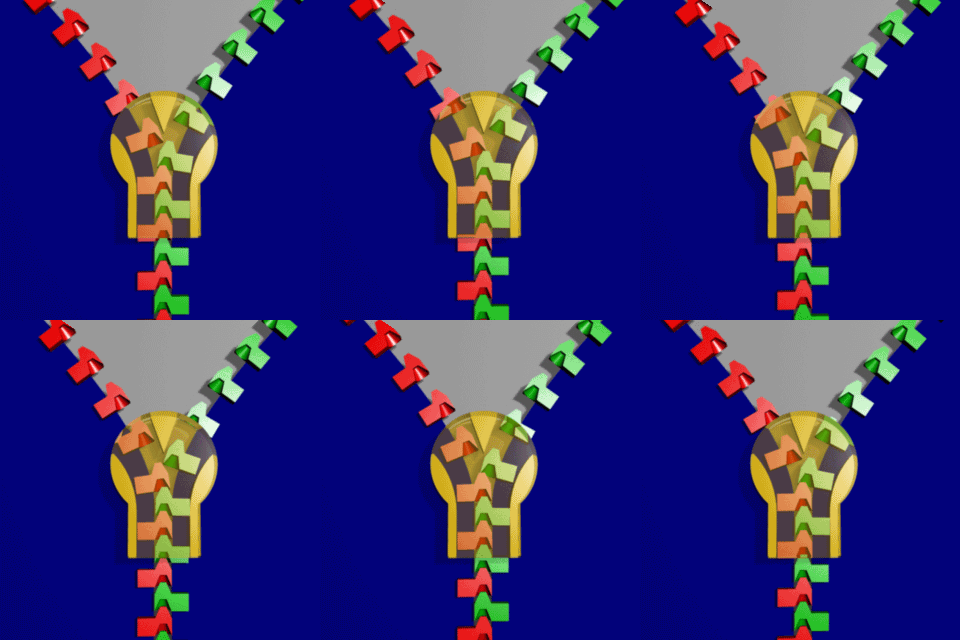
(I think I'd like it better if there were more than two strands, but it gets the idea across.)
As a special bonus, it turns out that Wolphram put his whole book online. Very cool stuff. Here it is: http://www.wolframscience.com/nksonline/toc.html
-Odds

Odds,
ReplyDeleteThere's some pretty fun stuff to think about there. I used to make a lot of my fellow atheists a little mad with this little diddy:
Hold a coin, ready to flip it. There is currently a 50% chance of heads and a 50% chance of tails, give or take. Once the coin has landed, there is a 100% of the one outcome and a 0% chance of the other. I believe that between the two events, the chances slid to one side, rather than just changed, e.g. the force and trajectory of the flip, the wind, humidity levels, the height it is caught at, the type of catch, etc., these all add or subtract to the likelihood of a given outcome during a very short event.
I like to think of fate and free will in a similar sense. Let's change the coin to a six-sided die. The chances of rolling a not-6 are about 83%. Perhaps your chances of some particular thing in life are about 83% against, 17% for. Some of you may have seen the film Gattaca, where the hero's chances of becoming an astronaut were much lower than 17%, but a systematic free-will campaign waged against the series of circumstances against him tipped the scale (you might know it by its common name, "determination"). I think of events a lot like elections, as long as 51% of the voting body is behind you, the opposing 49% can go to hell. So as that coin or die toss approaches its inevitable 100% chance outcome from however low it may have started, either fate or free will just has to suck it and admit defeat this round.
I find this particularly helpful for understanding sociological issues, culture patterns, human psychology, and even criminal profiling. Statistical trends are only half the battle, what happens on the micro-individual level has a s much to do with any outcome as the macro-statistical level. Free will and fate.
The spot where I tend to get myself in trouble is whether time is linear in one direction or two (maybe more?). If time "started" and goes one direction, all this is fine and good. But if the future has already occurred just as much as the past but it's our perception that's limited, then absolutely everything is fated, and any sliver of chance or free will is entirely fraudulent. =/