
We'll take a really smart guy, with like a 165 IQ, who had a 3.4 average in college (maybe a cultural anthropologist or a moral philosopher... hell, both!), who's well traveled, has had a lot of different and exciting jobs - like he's acted a personal bodyguard to the director of the FBI and the chairman of the joint chiefs of staff - and he's held managerial positions and been a private consultant and all sorts of other fun stuff...
Anyway, we'll take this guy, and he'll be funny and good with people too, and we'll drop him in a state with the worst economy possible for a first-world country. And after five months of being unemployed and about 35 job applications later, he'll get a job... at Wal-Mart... as a cart pusher... part time. It will be a fricken riot! Like Idiocracy, but set in the present. It'll be the best thing since sliced toast.
Tuesday, June 30, 2009

Sunday, June 28, 2009
so hungry, i got the shakes
So here I am, waiting for my 3 tacos de barbacoa to kick in, about to get ready for this week's hash.
Since I wrote my first log about hashing, I have become addicted. Really. So much, that other people have noticed. Usually, after a run, when I am trying to go to sleep I find that I can't because my mind is racing about how fun the day's run was. At work, I get antsy because I am thinking of running.
On top of that, I also got named. I feel more a part of the group. I feel like I am making friends. We've gone for sushi, hung out, we chat. I've actually made friends. I hope I am smart enough to keep up with this and not let it be a flame that burns out fast, because 1) running is healthy and 2) these folks, for the most part, seem like great people. The sushi place is owned and run by some hashers and there are photos on the wall of hashers who helped them get the place open for free.
On another note, I bought a running skirt. Best running gear decision I've ever made. =)
Happy Sunday!
On-on!
Since I wrote my first log about hashing, I have become addicted. Really. So much, that other people have noticed. Usually, after a run, when I am trying to go to sleep I find that I can't because my mind is racing about how fun the day's run was. At work, I get antsy because I am thinking of running.
On top of that, I also got named. I feel more a part of the group. I feel like I am making friends. We've gone for sushi, hung out, we chat. I've actually made friends. I hope I am smart enough to keep up with this and not let it be a flame that burns out fast, because 1) running is healthy and 2) these folks, for the most part, seem like great people. The sushi place is owned and run by some hashers and there are photos on the wall of hashers who helped them get the place open for free.
On another note, I bought a running skirt. Best running gear decision I've ever made. =)
Happy Sunday!
On-on!
Friday, June 26, 2009
The real reason I'm in science...
Sup Monkeys
I hope you are all doing well. Pardon me while I talk about something unintelligent for a while. I spent my whole week trying to talk about intelligent things and, well, I'm sick of it.
Do you guys know how awesome the Ghostbusters were? Really really awesome. I briefly played the new "Ghostbusters" video game this week, and was reminded of this. They battle ghosts... with particle accelerators strapped to their backs... and fight giant marshmallows. It's an ok game, as far as video games go, but nothing great. And yet, I marveled at it, entranced by every little pixel, really really jaw dropping, eyes wide staring. I have no explanation for this sudden obsession with a game I don't even own, other than to say it struck a chord in me I haven't heard in a long time. Particle accelerators you wear on your back! I wanted this world. Containment units and traps activated by foot pedals!! The reality the game portrayed, I desired to live in it. PKE meters and nerdy secretaries!!! I feel I was born, nay, destined to be a ghostbuster!
Let's just run down this quick employment questionnaire:
1.) Heavy science background? Check.
2.) Deep interest in the paranormal? Checko.
3.) Look good in tan overalls? Aw, you know it!
4.) Drink enough ecto-cooler your skin turned a bit green? *burp*
5.) First reaction when woken up by an alarm? Find nearest firepole and/or particle accelerator.
6.) 'fraid of no ghost? I ain't!
Sometimes, when I think it might rain, I hang my umbrella in my backpack in such a position that I must reach up over my shoulder to retrieve it, proton-pack style. When I'm wearing my "pack" like this, I feel like a better scientist. I read papers more diligently. I wish I was making that part up.

I wish it would look like rain more often.
I hope you are all doing well. Pardon me while I talk about something unintelligent for a while. I spent my whole week trying to talk about intelligent things and, well, I'm sick of it.
Do you guys know how awesome the Ghostbusters were? Really really awesome. I briefly played the new "Ghostbusters" video game this week, and was reminded of this. They battle ghosts... with particle accelerators strapped to their backs... and fight giant marshmallows. It's an ok game, as far as video games go, but nothing great. And yet, I marveled at it, entranced by every little pixel, really really jaw dropping, eyes wide staring. I have no explanation for this sudden obsession with a game I don't even own, other than to say it struck a chord in me I haven't heard in a long time. Particle accelerators you wear on your back! I wanted this world. Containment units and traps activated by foot pedals!! The reality the game portrayed, I desired to live in it. PKE meters and nerdy secretaries!!! I feel I was born, nay, destined to be a ghostbuster!
Let's just run down this quick employment questionnaire:
1.) Heavy science background? Check.
2.) Deep interest in the paranormal? Checko.
3.) Look good in tan overalls? Aw, you know it!
4.) Drink enough ecto-cooler your skin turned a bit green? *burp*
5.) First reaction when woken up by an alarm? Find nearest firepole and/or particle accelerator.
6.) 'fraid of no ghost? I ain't!
Sometimes, when I think it might rain, I hang my umbrella in my backpack in such a position that I must reach up over my shoulder to retrieve it, proton-pack style. When I'm wearing my "pack" like this, I feel like a better scientist. I read papers more diligently. I wish I was making that part up.

I wish it would look like rain more often.
Wednesday, June 24, 2009
STORIES ARE DATA COMPRESSION
Last week I watched 'Good Will Hunting' for the first time in about five or six years. This reminded me of the fact that whenever I watch an old favorite that I know well but haven't seen for a long time, I'm struck by the economy of the storytelling. The story always seems so full in my head that I'm shocked that crucial pieces are accomplished with so little screen time. For example, the whole establishment and development of Will and Skylar's relationship in 'Good Will Hunting' is told in four scenes, yet you come away with a very clear sense of who they are together. In Star Wars, the whole galaxy is set up in maybe 10 minutes.
Here's the half-baked thought of the week.
Stories are like mp3's: both rely on data compression. When you watch a good movie, they don't show you everything. Instead, they show you just enough of just the right things for your brain to automatically fill in all the pieces. It's like how an mp3 only plays the loudest sound when multiple ones are in the audio stream at once; you don't notice the others are missing for a few milliseconds because your brain automatically fills them in.
This is a good thing in movies because we don't have time to watch everything happen in a time-line, piece by piece, and it wouldn't feel like a story if we did. Here's a bold claim: If there's no data compression, no selection of salient pieces, there's no story. Or at least not a good one (think of a 4 year-old's listing of every little detail, "and then x, and then x, and then x...").
I think all this data compression is a useful strategy for dealing with the limits of human memory and processing capacity. We can only fit so much explicit information in our heads at one time, so narrative algorithms help us make the most of it.
FREE BONUS FEATURE:
I found this article on how the brain treats tools as temporary body parts. I can't remember if I've linked to this Ed Yong science-blogging fellow before, but he's really clear.
Here's the half-baked thought of the week.
Stories are like mp3's: both rely on data compression. When you watch a good movie, they don't show you everything. Instead, they show you just enough of just the right things for your brain to automatically fill in all the pieces. It's like how an mp3 only plays the loudest sound when multiple ones are in the audio stream at once; you don't notice the others are missing for a few milliseconds because your brain automatically fills them in.
This is a good thing in movies because we don't have time to watch everything happen in a time-line, piece by piece, and it wouldn't feel like a story if we did. Here's a bold claim: If there's no data compression, no selection of salient pieces, there's no story. Or at least not a good one (think of a 4 year-old's listing of every little detail, "and then x, and then x, and then x...").
I think all this data compression is a useful strategy for dealing with the limits of human memory and processing capacity. We can only fit so much explicit information in our heads at one time, so narrative algorithms help us make the most of it.
FREE BONUS FEATURE:
I found this article on how the brain treats tools as temporary body parts. I can't remember if I've linked to this Ed Yong science-blogging fellow before, but he's really clear.
Insurance... of what?
My grandfather has been in the hospital for the last couple of weeks. He had a heart attack and they discovered his heart was pumping very weakly. They said he'd need a triple bypass, and soon. But he wasn't strong enough to be ready for surgery, so he stayed for a week and some change while they tried to get him strong enough for the procedure. He was doing well enough for them to move him out of the ICU after a few days, and spent the rest of the time in a normal room. After almost two weeks of tests, consultations, room and board, and the various other costs related to an extended hospital stay, Medicare began to pester the hospital as to when they would be able to perform the surgery. The hospital kept saying, "We can't know yet." So today, the hospital, after finding out that medicare wouldn't cover anything else, since it wasn't leading up to a particular surgery, discharged my grandfather - who until today was still on an IV and had a catheter in. He's not in good enough shape for the retirement apartment he lives in to take him back, so our family had to put him into a nursing home, until he is strong enough to go back to his apartment to eventually pay the consequence for not receiving the bypass.
So I remain confused as to exactly what insurance insures. He had a heart attack, needs a bypass, isn't strong enough to return home, and needs medical assistance for basic human functions... and medicare decided he didn't need to be in the hospital anymore.
So I remain confused as to exactly what insurance insures. He had a heart attack, needs a bypass, isn't strong enough to return home, and needs medical assistance for basic human functions... and medicare decided he didn't need to be in the hospital anymore.
Monday, June 22, 2009
Nightstand
I opened up the top drawer of my nightstand last evening and had to chuckle. For those of you not from the area a night stand it is a little bit of furniture placed next to your preferred side of the bed. Typically it holds an alarm clock and maybe the book you're reading on its top and miscellaneous what-have-yous in its drawers. The nightstand that I'm currently in possession of belonged to part a of a bedroom set at my grandmother's house in Detroit. Ironically its current contents would lead you to believe it hasn't left. The furniture itself is well constructed, hand build in in western Michigan like most furniture you'll find in that region. The set is a bit worn down, missing handles, screws replaced with non-OEM doppelgangers and one of the glass tops is missing. However, the solid construction and ability to hold items supersedes these minor (if not character building) defects.
The top of my nightstand is adorned with a small $5 desk lamp and the book I'm currently reading (The End of Overeating). I have no alarm clock, I hate them, the "alarming" sound they produce, while waking me up, also results in a short but unpleasant heart arrhythmia. My fiancee has a sun alarm which amounts to an absurdly bright light that slowly powers up as the clock approaches the desired wake up time. This is a bit irrelevant since the normal sun is cruising up at about the same time. By the way my fiancee's nightstand is a simple table height bar stool, no drawers, just a top. It looks a bit eccentric but also did not block the heating/cooling vent in our old house. Now it just looks eccentric but at least the color is close to the other furniture so a quick scan of the room leads you to believe it's part of the set.
I'm not sure what people typically keep in the drawers of nightstands. I didn't really have one until 2005 when I got this furniture set. Prior to that I had maybe a computer desk or a window sill which typically held my former nemesis, the dreaded alarm clock. Thinking back I cannot believe how many years I used an alarm clock for. It wasn't until I had a job which did not rely on my showing up at a particular time that I was able to break free. The only nightstands I was really ever familiar with belonged to my parents. They had a matching pair each with a wide drawer at the top and a pair of doors to close off the contents of the lower 2/3rds. On them were two matching lamps, two alarm clocks and my mother had a phone on hers. Being a doctor required you to be able to pick up the phone and answer detailed, often life threatening questions, in the middle of the night. Who wants to get out of bed for that? They actually kept reading material in the drawer and the lower cabinet. The drawers themselves were full of loose papers and who knows what. I remember if you asked where nail clippers were one of those drawers had some.
Regardless I don't keep nail clippers in my nightstand and I don't keep scraps of paper laying around so what belongs in a nightstand? Things you need at night? Things you need in a bedroom? Fortunately for you the reader and me the author I have a copy of Martha Steward's Homekeeping Handbook. OK never mind, we are not fortunate the handbook just says a nightstand needs to be large enough to accommodate your "needs". So I guess I'm supposed to keep my needs in my nightstand. It turns out that my needs make me laugh every time I look at them. Below is a picture of the contents of the top drawer of my nightstand.

The top of my nightstand is adorned with a small $5 desk lamp and the book I'm currently reading (The End of Overeating). I have no alarm clock, I hate them, the "alarming" sound they produce, while waking me up, also results in a short but unpleasant heart arrhythmia. My fiancee has a sun alarm which amounts to an absurdly bright light that slowly powers up as the clock approaches the desired wake up time. This is a bit irrelevant since the normal sun is cruising up at about the same time. By the way my fiancee's nightstand is a simple table height bar stool, no drawers, just a top. It looks a bit eccentric but also did not block the heating/cooling vent in our old house. Now it just looks eccentric but at least the color is close to the other furniture so a quick scan of the room leads you to believe it's part of the set.
I'm not sure what people typically keep in the drawers of nightstands. I didn't really have one until 2005 when I got this furniture set. Prior to that I had maybe a computer desk or a window sill which typically held my former nemesis, the dreaded alarm clock. Thinking back I cannot believe how many years I used an alarm clock for. It wasn't until I had a job which did not rely on my showing up at a particular time that I was able to break free. The only nightstands I was really ever familiar with belonged to my parents. They had a matching pair each with a wide drawer at the top and a pair of doors to close off the contents of the lower 2/3rds. On them were two matching lamps, two alarm clocks and my mother had a phone on hers. Being a doctor required you to be able to pick up the phone and answer detailed, often life threatening questions, in the middle of the night. Who wants to get out of bed for that? They actually kept reading material in the drawer and the lower cabinet. The drawers themselves were full of loose papers and who knows what. I remember if you asked where nail clippers were one of those drawers had some.
Regardless I don't keep nail clippers in my nightstand and I don't keep scraps of paper laying around so what belongs in a nightstand? Things you need at night? Things you need in a bedroom? Fortunately for you the reader and me the author I have a copy of Martha Steward's Homekeeping Handbook. OK never mind, we are not fortunate the handbook just says a nightstand needs to be large enough to accommodate your "needs". So I guess I'm supposed to keep my needs in my nightstand. It turns out that my needs make me laugh every time I look at them. Below is a picture of the contents of the top drawer of my nightstand.

- The obvious. Handgun, safety off. Why, who knows I'm not planning on getting robbed.
- 10 Trojan "Her Plesure" condoms. Why that's obvious.
- A compass, incase I need to um, ... know which direction I'm facing?
- A key with a LED key fob. Dual usage opens something and provides light to see the compass in the dark.
- A journal, which belongs to my fiancee (she doesn't have any drawers in her nightstand).
- A pen for the journal.
- Several hair ties, see item 5.
- A MI trailer registration, I guess that's my scrap of paper.
- Sticky notes.
- An Ironman Timex watch with velcro wrist strap.
- Wall charger for a Motorola RAZR phone, we have one of these in every drawer of the house. We have two of these phones (one is just a spare) and my now lost Bluetooth headset used the same charger.
- On fitted sheet clip, for keeping your fitted sheet in place. They work great, if you have four of them, but suck to put on.
- Chapstick, you can never have enough chapstick.
So based on most video games I've played this is the inventory for someone who has amneisa and is about to be attacked by zombies or mutants. Some of the items make sense, some will require a bit of quick thinking to put to use. Either way when the zombies attack I'll be ready.
Sunday, June 21, 2009
The Coders Dilemma
Apologies from the outset. I was waylaid this weekend by a brutal combination of friends, beaches, water, and sunshine, and this is the my first chance in front of a computer since Thursday. So, I suppose my apologies aren't THAT sincere.
I make no secret of the sheer hours I spend in front of a liquid crystal display. I try and make up for this by working with a laptop under the shade of trees as often as permits. Sadly, such a situation, like uncooked meat, is rare.
While a large fraction of this time can be written off as "goofing", a plenty sizable chunk is spent knee deep in code. Codes to generate morphologies, codes to analyze the electronics of a structure, codes to simulate the life and times of an elemental particle, codes to talk to other computers, codes to talk to other codes, codes codes codes.
Writing code, good code anyway, is an art. The prose and syntax of ones functions, the choice between concise elegance or extended clear definitions, and even an individuals personal indentation architecture, these all feed into the individuality of each programmers technique. The sound of their own voice, the shape of their brush, and the colors on their pallet.
But who ever said art has to be slow and methodical. Who ever said art has to be good. Sometimes, you don't need to compose a masterpiece. Those are the times you just need to get something done, quick and dirty. And there is nothing wrong with that! Some of the my very best strokes of the keyboard have been under last minute conditions.
The problem with "shotgun" code, really, comes when you return to it. What exactly does that giant array "musfss" do anyway? Why did you name it that? Logic algorithms you might recall as being devilishly straightforward and ingenious will appear, upon reexamination by the author, hieroglyphic. My kingdom for a comment.
And there is the coders dilemma. How fast do you stroll? Slow and steady will be readable years from now, but you'll miss out on many of those wonderful moments of brilliance which always seem to lose their way if you sit down and try to explain them beforehand, even to yourself.
On a side note, happy fathers day everyone. Anybody else have a father in rehab right now? Good times.
I make no secret of the sheer hours I spend in front of a liquid crystal display. I try and make up for this by working with a laptop under the shade of trees as often as permits. Sadly, such a situation, like uncooked meat, is rare.
While a large fraction of this time can be written off as "goofing", a plenty sizable chunk is spent knee deep in code. Codes to generate morphologies, codes to analyze the electronics of a structure, codes to simulate the life and times of an elemental particle, codes to talk to other computers, codes to talk to other codes, codes codes codes.
Writing code, good code anyway, is an art. The prose and syntax of ones functions, the choice between concise elegance or extended clear definitions, and even an individuals personal indentation architecture, these all feed into the individuality of each programmers technique. The sound of their own voice, the shape of their brush, and the colors on their pallet.
But who ever said art has to be slow and methodical. Who ever said art has to be good. Sometimes, you don't need to compose a masterpiece. Those are the times you just need to get something done, quick and dirty. And there is nothing wrong with that! Some of the my very best strokes of the keyboard have been under last minute conditions.
The problem with "shotgun" code, really, comes when you return to it. What exactly does that giant array "musfss" do anyway? Why did you name it that? Logic algorithms you might recall as being devilishly straightforward and ingenious will appear, upon reexamination by the author, hieroglyphic. My kingdom for a comment.
And there is the coders dilemma. How fast do you stroll? Slow and steady will be readable years from now, but you'll miss out on many of those wonderful moments of brilliance which always seem to lose their way if you sit down and try to explain them beforehand, even to yourself.
On a side note, happy fathers day everyone. Anybody else have a father in rehab right now? Good times.
The whole truth and nothing but the truth...
Today, while driving home from a weekend camping I became kind of furious. I'm not much for fury, so this is a pretty big deal - really!
As usual when driving home at about 10 AM on a Sunday, I am listening to NPR's This American Life and this week's show was about "origins." The particular story that invoked all of my wrath concerned US v Reynolds, the US Supreme Court case from 1952 that set the precedent for the State Secrets Privilege to be used by the government to throw out court cases for the purpose of protecting state secrets and sensitive information that may be of use to enemies.
It started when 3 civilian engineers working on a "secret project" for the government where killed in a B-29 operated by the US Air Force in 1948. The widows of the engineers sued the government for negligence and won due to the fact that the government refused to provide the accident report, claiming state secrets would be revealed. The judge in the case even offered to review the report privately, in chambers, to avoid any public display of the secrets. The government refused and the judge made award to the widows by default. The government appealed and lost, but kept appealing until it reached the Supreme Court. The Supreme Court took the opposite stand, stating that they trusted the government enough not to see the accident report and that state secrets ought to be protected. After the ruling, the widows and the government settle 170,000 per family with a release of liability.
Fast forward to 2000, where the one of the daughters of the engineers finds the (now) declassified accident report containing no state secrets at all but claiming negligence on the part of the Air Force in the maintenance and operation of the B-29.
The fact is a number of cases were decided following this precedent and now, it seems we are stuck with it. If you feel like listening, I do recommend it: http://www.thisamericanlife.org/
The first act was pretty good too.
As usual when driving home at about 10 AM on a Sunday, I am listening to NPR's This American Life and this week's show was about "origins." The particular story that invoked all of my wrath concerned US v Reynolds, the US Supreme Court case from 1952 that set the precedent for the State Secrets Privilege to be used by the government to throw out court cases for the purpose of protecting state secrets and sensitive information that may be of use to enemies.
It started when 3 civilian engineers working on a "secret project" for the government where killed in a B-29 operated by the US Air Force in 1948. The widows of the engineers sued the government for negligence and won due to the fact that the government refused to provide the accident report, claiming state secrets would be revealed. The judge in the case even offered to review the report privately, in chambers, to avoid any public display of the secrets. The government refused and the judge made award to the widows by default. The government appealed and lost, but kept appealing until it reached the Supreme Court. The Supreme Court took the opposite stand, stating that they trusted the government enough not to see the accident report and that state secrets ought to be protected. After the ruling, the widows and the government settle 170,000 per family with a release of liability.
Fast forward to 2000, where the one of the daughters of the engineers finds the (now) declassified accident report containing no state secrets at all but claiming negligence on the part of the Air Force in the maintenance and operation of the B-29.
The fact is a number of cases were decided following this precedent and now, it seems we are stuck with it. If you feel like listening, I do recommend it: http://www.thisamericanlife.org/
The first act was pretty good too.
Saturday, June 20, 2009
Non sequitur attack
Khameni (or is it Khamen'i?) gave a speech that hits the usual points in condemning the US:
1) We made a mess of Iraq
2) We're actively making a mess in Pakistan
3) and, of course, Afghanistan
but then:
4) in 1993, Hillary's husband, some guy named Bill, had the ATF storm the Branch Davidian compound in Waco, TX and burn 80 people alive.
The Iranian bloggers reported that he said something along the lines of:
"during the time of power of the husband of the current Secretary of State, these Democrats burned 80 supporters of the Davidian Cult alive." The speech was posted on some Twitter thing, then translated and then re-posted by Andrew Sullivan, but its hard to imagine that someone made it up or mis-translated it that badly. They even pointed out other mis-translations from the speech. I wonder who wrote that in the speech. Are Iranians and the world community familiar enough with Waco that it can just be casually mentioned? I forgot about that until this. Maybe a good example of American hypocrisy in condeming a contested election result would be to bring up an example of a contested election in America?! I wonder if they thought about mentioning 2000, but then realized that no one got violent over it, and then searched for an instance of violence during a Democratic presidency. Ah, Waco! Perfect.
Thursday, June 18, 2009
Explaining America
It started innocently. I was reading email over my first cup of coffee when my coworkers approached me with a problem. One of our products was not functioning properly. After describing the failure mode I had a hunch as to what the problem was. Being a huge fan of the scientific method, I immediately requested that we do some testing to prove out my theory. That and the notion that proving my ideas through testing is a safe bet to justify spending thousands of dollars on tool reworking. So, I asked simply, can we perform the tests. The answer was of course, no, due to us not having anything more than a screw driver and a hammer in our office. Thus began the first major lesson on Western thinking.
It started off innocently. We needed to buy some c-clamps to conduct some testing. We went to the first store, they had nothing except some Vise Grips. I bought them in on the spot. When asked why, I simply said that I wanted them. The next store also did not have c-clamps, but they did have a nice hex key set, so I purchased that as well. Now they thought I was being superfluous. At the final store, I hit the American Male Mecca. It was basically a hardware store. I spent a lot of Thesearefakedollars which turned out to be about 50 USD and bought clamps, pliers, socket sets, Dremel tools, a lot of stuff. My coworkers were looking at me like I was crazy. They kept asking, what do you need this for, or, why buy 2? I explained that you need two clamps minimum because if you clamp something down in one spot it can still rotate. This was understood by the engineers, not by the purchasing person.
After we got back to the office, the office manager was a little peeved at all the things I bought. He too thought it was a waste of money. I explained that sure, I have no need for these now, but these are all very common tools and we will be sure to use them soon enough and they will be nice to have around. I also explained that I bought them with my own money so he need not worry.
I didn't keep exact count, but I think it was less than 2 hours after I got back in the office that over 75% of the tools I bought were in use. My coworkers were a little shy at first, just asking to borrow them. After a little time they realized, holy shit, this is much easier now that I have the right equipment and they used them like crazy. After this the office manger gave me a reinbursement for the tools and stated, wow, this is great. We had no idea how useful these would be. I explained that this is genetic. I can not control my love for tools and their justification simply makes me love them even more. He then presented me with a list at the end of the day of other things they would like to do and asked that I pick out more tools tomorrow.
I know this is a very simple thing to most people, but after today I have realized that this is truly a western point of logic. It's easy for people in the US to wander into Home Depot or Lowes and get lost in the aisles and not think anything of it. After hunting for c-clamps for a couple hours and walking around in sweltering heat I was elated to find an actual hardware store. I also feel as if I was able to define the Boy Scout Motto to my fellow coworkers. (To the non-boy scouts, the motto is: Be Prepared.) I am excited to buy more tools tomorrow, and I hope you can share this excitement with me.
Thisisafakename
It started off innocently. We needed to buy some c-clamps to conduct some testing. We went to the first store, they had nothing except some Vise Grips. I bought them in on the spot. When asked why, I simply said that I wanted them. The next store also did not have c-clamps, but they did have a nice hex key set, so I purchased that as well. Now they thought I was being superfluous. At the final store, I hit the American Male Mecca. It was basically a hardware store. I spent a lot of Thesearefakedollars which turned out to be about 50 USD and bought clamps, pliers, socket sets, Dremel tools, a lot of stuff. My coworkers were looking at me like I was crazy. They kept asking, what do you need this for, or, why buy 2? I explained that you need two clamps minimum because if you clamp something down in one spot it can still rotate. This was understood by the engineers, not by the purchasing person.
After we got back to the office, the office manager was a little peeved at all the things I bought. He too thought it was a waste of money. I explained that sure, I have no need for these now, but these are all very common tools and we will be sure to use them soon enough and they will be nice to have around. I also explained that I bought them with my own money so he need not worry.
I didn't keep exact count, but I think it was less than 2 hours after I got back in the office that over 75% of the tools I bought were in use. My coworkers were a little shy at first, just asking to borrow them. After a little time they realized, holy shit, this is much easier now that I have the right equipment and they used them like crazy. After this the office manger gave me a reinbursement for the tools and stated, wow, this is great. We had no idea how useful these would be. I explained that this is genetic. I can not control my love for tools and their justification simply makes me love them even more. He then presented me with a list at the end of the day of other things they would like to do and asked that I pick out more tools tomorrow.
I know this is a very simple thing to most people, but after today I have realized that this is truly a western point of logic. It's easy for people in the US to wander into Home Depot or Lowes and get lost in the aisles and not think anything of it. After hunting for c-clamps for a couple hours and walking around in sweltering heat I was elated to find an actual hardware store. I also feel as if I was able to define the Boy Scout Motto to my fellow coworkers. (To the non-boy scouts, the motto is: Be Prepared.) I am excited to buy more tools tomorrow, and I hope you can share this excitement with me.
Thisisafakename
Bailouts
Hi team, I missed a night of sleep this week, and have felt a day behind ever since...
Here is an astounding graphic I came across this morning. It's an inflation-adjusted chart of the money spent on bail-outs in the past year vs. all previous one-shot expenditures (click on the image to see it large enough to actually read):

(http://www.ritholtz.com/blog/2009/06/bailout-costs-vs-big-historical-events/)
Nothing else even comes close to the amount of money we're dropping. This is not good. It rather seems to me that "too big to fail" may also mean "too big to save", at least without serious long-term ramifications to the value of our currency. Of course if the government wasn't spending all this stimulus/ bailout money it would be disappearing anyways due to liquidity issues and everyone cutting back at once, but so it goes.
Hey, at least we're mostly still young enough to tell our kids that it was all our parents fault.
Here is an astounding graphic I came across this morning. It's an inflation-adjusted chart of the money spent on bail-outs in the past year vs. all previous one-shot expenditures (click on the image to see it large enough to actually read):
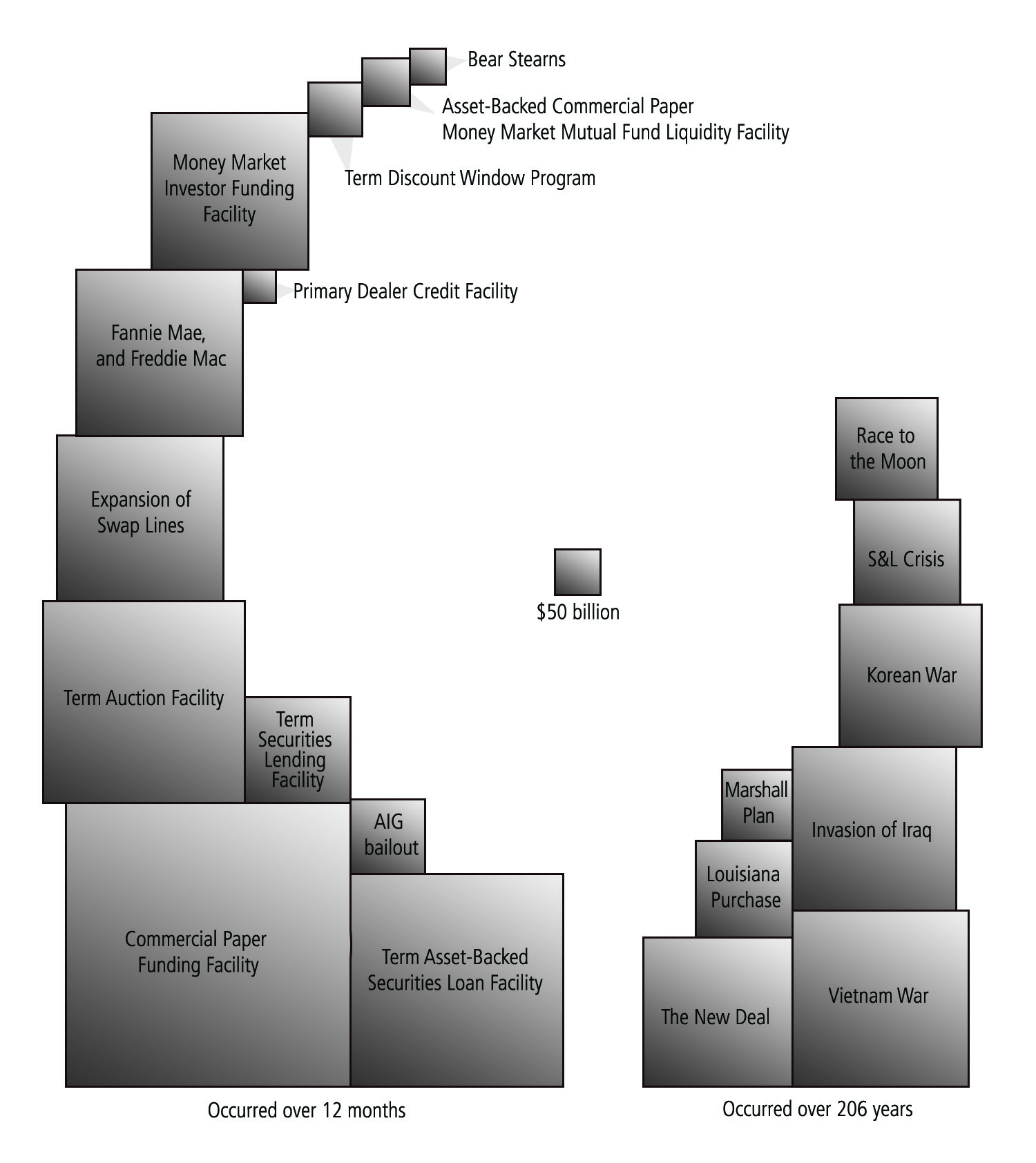
(http://www.ritholtz.com/blog/2009/06/bailout-costs-vs-big-historical-events/)
Nothing else even comes close to the amount of money we're dropping. This is not good. It rather seems to me that "too big to fail" may also mean "too big to save", at least without serious long-term ramifications to the value of our currency. Of course if the government wasn't spending all this stimulus/ bailout money it would be disappearing anyways due to liquidity issues and everyone cutting back at once, but so it goes.
Hey, at least we're mostly still young enough to tell our kids that it was all our parents fault.
Tuesday, June 16, 2009
Make a bold claim.
I'm going to make some bold claims:
I'm smarter than 93% of the people around me.
I can beat 99% of the people around me in a sword fight.
I'm a better driver than 80% of the people around me.
I'm better in bed than 92.47% of the people around me.
I'm better than 7% of the people around me at contributing to a blog.
I can chug more of a gallon of milk than 81% of the people around me.
I spend more time on the internet than 45% of the people around me.
Alright, monkeys, what are your bold claims?
I'm smarter than 93% of the people around me.
I can beat 99% of the people around me in a sword fight.
I'm a better driver than 80% of the people around me.
I'm better in bed than 92.47% of the people around me.
I'm better than 7% of the people around me at contributing to a blog.
I can chug more of a gallon of milk than 81% of the people around me.
I spend more time on the internet than 45% of the people around me.
Alright, monkeys, what are your bold claims?
Monday, June 15, 2009
goodbyes
I got home late last night from a trip to Michigan for my grandparents' 50th wedding anniversary. I was there from noonish Thursday until noonish Sunday and it is never enough time to see everyone I'd like to see (read: even you GUY).
The fact is, I am constantly saying goodbye. After the party, I was saying goodbye to fewer than 20 people and it still took an hour and a half. I am getting used to all the goodbyes, except at funerals. I still suck at goodbyes I know are permanent.
I promise to start writing on Sundays as promised.
The fact is, I am constantly saying goodbye. After the party, I was saying goodbye to fewer than 20 people and it still took an hour and a half. I am getting used to all the goodbyes, except at funerals. I still suck at goodbyes I know are permanent.
I promise to start writing on Sundays as promised.
Saturday, June 13, 2009
Thugs
The word thug comes to us from the Hindi word thuggee, and referred to a particularly infamous band of highwaymen. The thugs operated along the roads and rivers in India, emerging at night to strangle their victims with ceremonial silk scarves (very thoughtful of them to chose silk, I say). The British believed that the Thugs were a cult of Kali, driven to murder to show their devotion. Its hard to overstate the extent to which the rumors of the Thugs captured the British imagination. The Confessions of a Thug (1839), written by Philip Meadows Taylor, became an immediate best-seller. Queen Victoria demanded the publisher giver her a copy before it even went to proof. Other than all that unpleasant strangling business, the Thugs seems like the sort of gang most 10-year-old boys dream of joining. According to the book, Thugs were a shadowy cult who had infiltrated most levels of Indian society without suspicion. They had developed a secret language and set of signs to identify other Thugs. Each member of the group had a particular job, and rose in rank through an apprentice system. Since Indian highways were dangerous, merchants would band together in caravans for protection. Some Thugs would befriend members of a caravan, and then pass the word of the caravans movements to others. When the time was right, others would act as lookouts while the most thuggish Thugs descended and killed off the entire caravan.
British accounts generally focused on the cultish nature of the Thugs and their devotions to the goddess Kali. In reality, the Thugs were well-organized criminals who had adopted tactics to successfully raid caravans that individuals would fail to take down. Like other practitioners of risky occupations, the Thugs tended to be a superstitious bunch. Some Thugs also worshipped Kali, although this did not mark them as different from non-Thugs. The fact that Thugs were Hindus, Muslims and Sikhs casts doubt on the prospect that the killings were in honor of a Hindu goddess. In short, the Thugs seemed to be a plainly brutal set of criminals with effective methods. Another fellow with a notion for effective methods, Major William Sleeman, broke the Thugs. Realizing the group relied on its networks of operatives and coordination, he simply gave incentives for turning in members. Between his informants and the vast expansion in police power, the groups were soon gone and would only reappear in movies like Indiana Jones and the Temple of Doom.
Friday, June 12, 2009
Oooooh.... Aaaaahhh....

Fireworks. No matter if you have to cross state lines to buy them, make them in a chemistry class, or even get your thumb blasted off due to them, you have to admit they are pretty magical. They are LOUD, they are DIRTY, they are DANGEROUS, people turn to STARE when they start going off... fireworks are like really great sex. See, I too just realized that, so let's both just take a moment to reflect on it.
“Oooooh” says the crowd of families looking on from their lawn chairs. “Aaaaaah”
I think you could make a pretty convincing case that the purest form of science and engineering only exists when it is being directly applied to fireworks. Chemistry for the colors. Physics for the trajectories. Civil engineering for the... city permits.
And what are you supposed to do when you are watching fireworks? Well, nothing but watch them obviously. But rather, how does one prepare for the ritual? By cooking delicious things over open flame. Grilling out, baby! The focus should really be on the fireworks, so you don't want to have any technology around that is much more advanced than long fuses. It would ruin them moment. Loincloths are encouraged, but not required.
But what is the message fireworks send? I understand it is generally a positive one. Nobody says “Dude, I'm sorry about your dog getting hit by that car. That really sucks. Here are some M-80's. Feel better.” Maybe we should though. A somber funeral procession, followed shortly thereafter by a display high above, full of color and sound and fury! They shall say with hushed breath, “he died as he lived... exploding...”
The viking burials were, as I understand it, somewhat closer to my vision of a proper way to commiserate the passing of ones mortal flame. Plus, no clumsy cemeteries using up all your municipal areas parks, and I know you civil engineers will get a kick out of more municipal areas!
Does anybody have any romantic stories about fireworks? Anyones first kiss happen beneath skies adorned with rings red strontium, stars in bright yellow sodium, or streaks of blue copper halides? I had better hope not! What were you doing making googley eyes at each other while there were fireworks going on? Have you no sense of priorities. She's still gonna be there AFTER the explosions have stopped. Trust me, girls come and go, but fireworks are awesome all the time.

Thursday, June 11, 2009
Turning The Corner
It was about 3 p.m. today, (Thisisafaketimezone standard) when I was settling down a budding engineer regarding the troubles of his design when it finally occurred to me: I am getting old. With the first parts out of the mold in one hand and a set of calipers in the other, I couldn't help but focus on the young engineer and think about myself and my experiences/lessons learned in my first years of engineering. Although I didn't have a "moment" that required handkerchiefs and Hallmark Cards, thinking about this situation has really occupied my mind this evening. Thus, the topic of my post today.
First of all, studying in a university is less basic than basic training for the military in my honest opinion. Unless you are planning on working for a university, of course, which I realize a few of you are. Fortunately/unfortunately, depending on who you talk to, my internships helped me realize ahead of time that most of what I was going to learn in college was useless. Early on my coworkers explained to me that besides some basic trig/calc/physics, most of my classes would be more of a test of my mental endurance than instructions for becoming an engineer. I first met this with resistance, but after working in the "real world" for some time it occurred to me that they were dead on. Since graduation I have launched several projects and designed many products and never sniffed a line of calculus... thanks for 6 calculus classes Thisisafakeuniversity.
True, I left my university more educated than I was when I entered, this I can not deny. It made me a smarter/better person and dramatically improved my social and drinking skills as well. If there was one thing the classes directly taught me it was how to overcome adversity and prepare for a challenge. The course specifics changed every semester, however, preparing for a test remained the same. This in fact could have been the most significant thing I learned in school besides keg stands and euchre. Happily, exams ended when I graduated but reality set in quickly and it had its pro's and con's as well. Coping with the fact that I left school basically knowing nothing was a little hard to swallow. After all those classes, I basically knew how to do push ups but I didn't know how to play ball.
After a few months of OJT with some senior engineers I managed to get the freedom to do some designing on my own. This was not new in the fact that I was designing, I had done this as an intern. It was new in the fact that I was doing the work and sending the parts to prototype, not sending them to my boss for approval. After a month of hardcore CAD time I published my work in our system and sent a few critical parts to get prototyped. I was pumped, this was going to be perfect. Shock and awe. Well, both did in fact happen, but not in a good way. I learned just how big millimeters looked in person when my first prototypes came in. Many of the features I designed worked well, but they were just too small and not strong enough. I was embarrassed and devastated. My boss being experienced and wise looked at the whole thing as a win because what I designed was actually pretty good, it just needed to be scaled up a bit to add strength. Obviously a little peeved at my failure, I went directly back to my desk and started working again not bothering to look at the rest of the parts. My boss came up to me and kind of grinned and had a seat in my grey-blue stereotypical cubical and proceeded to give me the best professional advice I have yet to receive. He explained to me that nothing is ever going to be perfect the first time. (Duh, I was cocky and I thought bullshit, I should have got it right.) He went on to explain that yes, it could have been better. Yes, a lot of times it can come out right. However, regardless of this, it's how it ends that determines your paycheck. It's more important to be able to learn from the mistakes and react quickly to fix them than it is to be 100% perfect all the time. If you are perfect all the time, you will inevitably be put on another fubar'd project to help fix it. If you can't fix a problem, you are less valuable than those who can... even if they create them. Being naive, I didn't realize how true this really was. I truly thought, well screw that, I will just never screw up and I will be golden. Wrong. If I was the only person in my universe, this would work. However, I am not. As I have stated in previous posts, 50% of our population is below average in intelligence, and it's up to the others to pick up the slack. Maintaining yourself is a given, elevating those around you is success. Rolling back to my first design blunder, I am kind of happy I failed the way I did. It was not a big deal long term, the redesign worked great and the design is in production now and doing very well. The lesson I learned from it has made me a better overall person and engineer. This is very engineering specific but I think the same rule falls into place for life in general... within reason, of course.
All of this story fell into place today as my young engineer stood there with parts in his hand, totally miffed that they did not work. All of his dimensions were correct, the shape was how it should be, it just flat out didn't work. As I stood there and saw the frustration and embarrassment in his face I couldn't help but remember how I felt. This time, however, I was on the other side of the coin and had to give the pep talk. It all made a lot of sense at that moment. Being perfect is fine and dandy, however, being able to overcome problems is where the money is at. Unless of course you run a bank... or GM.
Thisisafakename
First of all, studying in a university is less basic than basic training for the military in my honest opinion. Unless you are planning on working for a university, of course, which I realize a few of you are. Fortunately/unfortunately, depending on who you talk to, my internships helped me realize ahead of time that most of what I was going to learn in college was useless. Early on my coworkers explained to me that besides some basic trig/calc/physics, most of my classes would be more of a test of my mental endurance than instructions for becoming an engineer. I first met this with resistance, but after working in the "real world" for some time it occurred to me that they were dead on. Since graduation I have launched several projects and designed many products and never sniffed a line of calculus... thanks for 6 calculus classes Thisisafakeuniversity.
True, I left my university more educated than I was when I entered, this I can not deny. It made me a smarter/better person and dramatically improved my social and drinking skills as well. If there was one thing the classes directly taught me it was how to overcome adversity and prepare for a challenge. The course specifics changed every semester, however, preparing for a test remained the same. This in fact could have been the most significant thing I learned in school besides keg stands and euchre. Happily, exams ended when I graduated but reality set in quickly and it had its pro's and con's as well. Coping with the fact that I left school basically knowing nothing was a little hard to swallow. After all those classes, I basically knew how to do push ups but I didn't know how to play ball.
After a few months of OJT with some senior engineers I managed to get the freedom to do some designing on my own. This was not new in the fact that I was designing, I had done this as an intern. It was new in the fact that I was doing the work and sending the parts to prototype, not sending them to my boss for approval. After a month of hardcore CAD time I published my work in our system and sent a few critical parts to get prototyped. I was pumped, this was going to be perfect. Shock and awe. Well, both did in fact happen, but not in a good way. I learned just how big millimeters looked in person when my first prototypes came in. Many of the features I designed worked well, but they were just too small and not strong enough. I was embarrassed and devastated. My boss being experienced and wise looked at the whole thing as a win because what I designed was actually pretty good, it just needed to be scaled up a bit to add strength. Obviously a little peeved at my failure, I went directly back to my desk and started working again not bothering to look at the rest of the parts. My boss came up to me and kind of grinned and had a seat in my grey-blue stereotypical cubical and proceeded to give me the best professional advice I have yet to receive. He explained to me that nothing is ever going to be perfect the first time. (Duh, I was cocky and I thought bullshit, I should have got it right.) He went on to explain that yes, it could have been better. Yes, a lot of times it can come out right. However, regardless of this, it's how it ends that determines your paycheck. It's more important to be able to learn from the mistakes and react quickly to fix them than it is to be 100% perfect all the time. If you are perfect all the time, you will inevitably be put on another fubar'd project to help fix it. If you can't fix a problem, you are less valuable than those who can... even if they create them. Being naive, I didn't realize how true this really was. I truly thought, well screw that, I will just never screw up and I will be golden. Wrong. If I was the only person in my universe, this would work. However, I am not. As I have stated in previous posts, 50% of our population is below average in intelligence, and it's up to the others to pick up the slack. Maintaining yourself is a given, elevating those around you is success. Rolling back to my first design blunder, I am kind of happy I failed the way I did. It was not a big deal long term, the redesign worked great and the design is in production now and doing very well. The lesson I learned from it has made me a better overall person and engineer. This is very engineering specific but I think the same rule falls into place for life in general... within reason, of course.
All of this story fell into place today as my young engineer stood there with parts in his hand, totally miffed that they did not work. All of his dimensions were correct, the shape was how it should be, it just flat out didn't work. As I stood there and saw the frustration and embarrassment in his face I couldn't help but remember how I felt. This time, however, I was on the other side of the coin and had to give the pep talk. It all made a lot of sense at that moment. Being perfect is fine and dandy, however, being able to overcome problems is where the money is at. Unless of course you run a bank... or GM.
Thisisafakename
Wednesday, June 10, 2009
The Semantics of Taoist Paradox: Part 2
When we last left off (here's part 1), I’d just explained that Taoist paradoxes flout the Gricean maxim of Manner by being deliberately obscure. In this segment I’ll talk about how we process that and what the point of it all is. Let’s start with another example from the Tao:
2) The master travels all day without leaving home.
While this statement at first seems paradoxical, we can make some sense of it if we think about it. This requires us to discard stereotypical word meanings and create a new semantic associations between two concepts. In 2), the paradox is based on the standard interpretation of “travel” in conjunction with the standard interpretation of “home.” “Home” is generally a fixed physical location, while “travel” describes the action of moving from one fixed location to another, generally on a large scale. If you interpret the sentence literally, those two typical interpretations bump up against one another. However, our Gricean Maxims tell us that the statement is meaningful… Great. So if we want to figure out what they actually meant, we’re going to have to shift the meaning of one of our contradictory definitions. While our original definitions of “travel” and “home” are the most stereotypical, they are by no means the only way in which they can be interpreted. We could redefine the scope of “travel” to make it more local, and decide that if the master has a large enough house, he travels all day by puttering from room to room. Or he could be “traveling” on the internet or in his memories. Or we could reinterpret the word “home” and think something like “mobile home” and picture him driving around all day in his bathrobe. But given the context of the text, these resolutions to the paradox fail different Gricean Maxims. The Maxim of relation tells us that the statement should be relevant, which in this case means that the statement should impart some form of philosophical wisdom, and none of the aforementioned resolutions appear to do so (not that I have anything against RV’s). A reinterpretation that may lie more in line with a Taoist thought relies on defining “home” as a state of mind. So we could reinterpret (2) to mean something like “The master feels at home wherever he travels,” i.e., “The master is at home within himself.”
3) He who defines himself does not know himself.
By applying the same maxims we used in 2) to 3), we are forced to reinterpret the meaning of “knowledge” to resolve the apparent paradox. Definitions are often considered to be an adequate basis for knowledge: if the statement refutes this, then we have to conclude we are talking about a different type of knowledge, “self-knowledge,” perhaps. If we take this interpretation, then we can conclude something like relying on labels doesn’t really tell you anything about who you are. That doesn’t sound so bad, but if this was what Long-ears wanted to say, why complicate things? What is the point in concealing meaning in a paradox that has to be unpacked? Why clothe all your messages in maxim violations?
One reason why this is a useful teaching method is that whenever we come across a maxim violation, our language processor focuses on it and raises our awareness of the entire discourse. We need to put more cognitive effort into processing it, and are forced to create our own meaning out of apparent nonsense. I’m sure you came up with your own interpretations to the last couple of examples that were nothing like mine. This internal process out to be a very effective teaching method; a student who comes to their own understanding of material values and understands it more than a student who is given facts to memorize in a lecture hall. If they’re willing to put the work in, that is, and not just give it up as a bunch of ancient nonsense. Intentionally using paradox is a way to give readers of the Tao Te Ching direct role in creating meaning from the text.
Another reason Taoist texts use paradox as a teaching tool is because it naturally emphasizes fluidity, one of the underlying tenets of the philosophy. The Tao Te Ching consciously attempts to get its readers to abandon rigidly held beliefs, and reading its contents constantly forces readers to discard stereotypical word definitions in their search for coherency. Apparent paradoxes are still paradoxical at face value, which illustrates meaning is itself fluid, and that rigid beliefs, like stereotypical definitions, only lead to further contradiction.
The fact that Taoist paradoxes can be resolved at all relies on the fluid interpretation of what linguists call open-class words (nouns, most verbs, adjectives, and adverbs). These are words that are added to the language freely, and whose meaning can change more easily over the time. The words that make up the remainder of the language are members of the closed-class (prepositions, determiners, auxilaries, and the like), which are resistant to change and are less open to free interpretation. Paradoxes based on these words are not so easily resolvable. Compare the resolvable paradox presented in 4) to the logical contradiction in 5):
4) The master stays behind; that is why she is ahead.
5) The tall man is not the tall man.
In 4), the paradox is based on the definitions of “behind” and “ahead.” We can redefine “ahead” to mean “better off,” and “behind” to mean, “not in front,” to get a meaning like, “The master is better off for not striving to be in front all the time.” In 5), however, the paradox is based on the closed-class words “is” and “not,” which are much harder to reinterpret.
So to summarize, Taoist teachings manipulate Gricean Maxims to get readers to resolve apparent paradox by reinterpreting the definitions of open-class words. By intentionally ignoring the Maxims of Manner, they force the readers to become more cognitively involved by generating their own meaning, which in turn reminds them of the fluid nature of words. This whole approach is itself a paradox, in that teaching with contradictions and obfuscation actually creates a clearer understanding of Taoist principles than stating them in a straightforward manner would. As they say in the Tao Te Ching:
We work with being, but non-being is what we use.
On a final note, the irony of pinning down a fluid philosophy using linguistic analysis is not lost on me. However, if I’ve done it in the right spirit, I think Old Long-ears would approve.
2) The master travels all day without leaving home.
While this statement at first seems paradoxical, we can make some sense of it if we think about it. This requires us to discard stereotypical word meanings and create a new semantic associations between two concepts. In 2), the paradox is based on the standard interpretation of “travel” in conjunction with the standard interpretation of “home.” “Home” is generally a fixed physical location, while “travel” describes the action of moving from one fixed location to another, generally on a large scale. If you interpret the sentence literally, those two typical interpretations bump up against one another. However, our Gricean Maxims tell us that the statement is meaningful… Great. So if we want to figure out what they actually meant, we’re going to have to shift the meaning of one of our contradictory definitions. While our original definitions of “travel” and “home” are the most stereotypical, they are by no means the only way in which they can be interpreted. We could redefine the scope of “travel” to make it more local, and decide that if the master has a large enough house, he travels all day by puttering from room to room. Or he could be “traveling” on the internet or in his memories. Or we could reinterpret the word “home” and think something like “mobile home” and picture him driving around all day in his bathrobe. But given the context of the text, these resolutions to the paradox fail different Gricean Maxims. The Maxim of relation tells us that the statement should be relevant, which in this case means that the statement should impart some form of philosophical wisdom, and none of the aforementioned resolutions appear to do so (not that I have anything against RV’s). A reinterpretation that may lie more in line with a Taoist thought relies on defining “home” as a state of mind. So we could reinterpret (2) to mean something like “The master feels at home wherever he travels,” i.e., “The master is at home within himself.”
3) He who defines himself does not know himself.
By applying the same maxims we used in 2) to 3), we are forced to reinterpret the meaning of “knowledge” to resolve the apparent paradox. Definitions are often considered to be an adequate basis for knowledge: if the statement refutes this, then we have to conclude we are talking about a different type of knowledge, “self-knowledge,” perhaps. If we take this interpretation, then we can conclude something like relying on labels doesn’t really tell you anything about who you are. That doesn’t sound so bad, but if this was what Long-ears wanted to say, why complicate things? What is the point in concealing meaning in a paradox that has to be unpacked? Why clothe all your messages in maxim violations?
One reason why this is a useful teaching method is that whenever we come across a maxim violation, our language processor focuses on it and raises our awareness of the entire discourse. We need to put more cognitive effort into processing it, and are forced to create our own meaning out of apparent nonsense. I’m sure you came up with your own interpretations to the last couple of examples that were nothing like mine. This internal process out to be a very effective teaching method; a student who comes to their own understanding of material values and understands it more than a student who is given facts to memorize in a lecture hall. If they’re willing to put the work in, that is, and not just give it up as a bunch of ancient nonsense. Intentionally using paradox is a way to give readers of the Tao Te Ching direct role in creating meaning from the text.
Another reason Taoist texts use paradox as a teaching tool is because it naturally emphasizes fluidity, one of the underlying tenets of the philosophy. The Tao Te Ching consciously attempts to get its readers to abandon rigidly held beliefs, and reading its contents constantly forces readers to discard stereotypical word definitions in their search for coherency. Apparent paradoxes are still paradoxical at face value, which illustrates meaning is itself fluid, and that rigid beliefs, like stereotypical definitions, only lead to further contradiction.
The fact that Taoist paradoxes can be resolved at all relies on the fluid interpretation of what linguists call open-class words (nouns, most verbs, adjectives, and adverbs). These are words that are added to the language freely, and whose meaning can change more easily over the time. The words that make up the remainder of the language are members of the closed-class (prepositions, determiners, auxilaries, and the like), which are resistant to change and are less open to free interpretation. Paradoxes based on these words are not so easily resolvable. Compare the resolvable paradox presented in 4) to the logical contradiction in 5):
4) The master stays behind; that is why she is ahead.
5) The tall man is not the tall man.
In 4), the paradox is based on the definitions of “behind” and “ahead.” We can redefine “ahead” to mean “better off,” and “behind” to mean, “not in front,” to get a meaning like, “The master is better off for not striving to be in front all the time.” In 5), however, the paradox is based on the closed-class words “is” and “not,” which are much harder to reinterpret.
So to summarize, Taoist teachings manipulate Gricean Maxims to get readers to resolve apparent paradox by reinterpreting the definitions of open-class words. By intentionally ignoring the Maxims of Manner, they force the readers to become more cognitively involved by generating their own meaning, which in turn reminds them of the fluid nature of words. This whole approach is itself a paradox, in that teaching with contradictions and obfuscation actually creates a clearer understanding of Taoist principles than stating them in a straightforward manner would. As they say in the Tao Te Ching:
We work with being, but non-being is what we use.
On a final note, the irony of pinning down a fluid philosophy using linguistic analysis is not lost on me. However, if I’ve done it in the right spirit, I think Old Long-ears would approve.
My apologies.
We're having a bit of a family emergency, and I don't really feel like having anything witty to say. Hopefully next week.
Tuesday, June 9, 2009
Timing is everything.
What the fuck people? Posting late is unacceptable in this business and excusses are for um, ..., the usual suspects. I was busy neutron scattering which leaves me on a bizzaro timeline. I actually think it's Monday and I won't find out it isn't until I finish this post. Not that it matters since I don't have much to write about. The locale I was scattering at was without internet access all weekend so I have no idea what's going on in the world. When I got home I saw my laptop was up to 8.93% complete up from 8.92% complete when I left Saturday morning. We have to new pledges in the lab so I'll have to train one in the fine art of research and coffee drinking in the afternoon. I assume he drinks coffee in the morning, if this turns out to be false I'll fire him on the spot. It's going to be a shitty summer. 3 undergrads have 10 weeks to turn out some decent results. They will walk in clueless and hopefully leave with ninja like research skillz. This sounds like it would make for a good youtube reality TV show. 3 enter, 3 leave, will the lab survive? I have to write two papers, finish getting the results for both and write a comphensive. I assume this is par for the course so it's not like I'm especially burderned with this. I'm out like a belly button.
Monday, June 8, 2009
latelatelate
Apologies or excuses should not be accepted, but would it help to tell you I was up pass 1 am doing E&M Physics? =( It probably won't.
Since it is just before 7:30 and I have to get ready to my desk job, I'll again have to keep this brief.
I was raised Catholic. Somewhere between seeing Fiddler on the Roof at 10 y/o and reading loads of literature on Judaism at about 15 y/o I decided I should become Jewish. By about age 20 I just could not believe in God anymore. I heard one former religious reporter on NPR go through something similar: Protestantism to Catholicism to nothing. He said it was "like a light switch going off."
I think that is the best description I ever heard. Only one of my brothers knows of my experience about religion and that is because I just told him over spring break this past March. He is the only person in my family - and I am damned close to my family. I just do not think they would understand that where I am religiously/ spiritually is not what I would consider a choice. If I could choose to believe in God, I would. Faster than you can say ... Because damnit it would make things a hell of a lot easier to deal with. The recent death of an aunt I was close to would not feel so permanent. I would have a community. For now, however, the light switch is just off.
Since it is just before 7:30 and I have to get ready to my desk job, I'll again have to keep this brief.
I was raised Catholic. Somewhere between seeing Fiddler on the Roof at 10 y/o and reading loads of literature on Judaism at about 15 y/o I decided I should become Jewish. By about age 20 I just could not believe in God anymore. I heard one former religious reporter on NPR go through something similar: Protestantism to Catholicism to nothing. He said it was "like a light switch going off."
I think that is the best description I ever heard. Only one of my brothers knows of my experience about religion and that is because I just told him over spring break this past March. He is the only person in my family - and I am damned close to my family. I just do not think they would understand that where I am religiously/ spiritually is not what I would consider a choice. If I could choose to believe in God, I would. Faster than you can say ... Because damnit it would make things a hell of a lot easier to deal with. The recent death of an aunt I was close to would not feel so permanent. I would have a community. For now, however, the light switch is just off.
Saturday, June 6, 2009
Historians sometimes ruin a good story
I was going to write about professional big game hunters in the 19th and early 20th century, but then I noticed that all the sources approached the subject with scathing condescension. In the end, I thought that the historians were more absurd and obnoxious than the hunters. Its true that hunting became an extension of European colonialism. Its also true that the hunters themselves were invariably over-the-top about how manly they were because they shot a bunch of animals and thus easy targets for ridicule. None of the sources really bothered to wonder why a bunch of intelligent guys with nearly unmatched resources decided the most worthy pursuit of all was hunting large animals far away from home. Modern condescension about the motives and beliefs of people who lived before us not only ruins all of the fun of telling good history but its also plainly embarassing. More seriously than just condemning the passtimes of the aristocracy, most history I've read can't seem to grasp why people thought what they did and evoke some sort of empathy for the times. By empathy I don't mean apologetics but rather an accurate understanding of why people did what they did. There are historians capable of doing this. I think Diarmaid MacCulloch's The Reformation: A History is one of most amazing histories I've read simply because it manages to make you understand why people were willing to kill each other because they "disagreed on whether, and how, bread and wine were transformed into God". If a modern, secular author can understand and foster an understanding of such strange and foreign thoughts, then that's really something. In the meantime, if I want to know why people used to go hunt lions I'll just have to do it myself.
Friday, June 5, 2009
Technology is Sexy
Hey everybody. I spent the last week coming up with a couple of different things to write about, and had actually half written some of them... on my macbook. Ooooh, macs are so great, they never crash. Macs are like airplanes. They RARELY crash, but... well let me just tell you in limerick:
There once was a mac on my desktop
who's permissions got totally messed up.
save my writings, I tried
but then FTP died
5 hours later, no luck, I should just stop
So yea. Pretty lame way to spend a Friday. I don't feel like recomposing anything on this computer after staring angrily at my other one all day. I think it's high time a take a walk. If I happen to see anybody who even remotely resembles the "I'm a mac" guy, I'm pushing them down an elevator shaft.
There once was a mac on my desktop
who's permissions got totally messed up.
save my writings, I tried
but then FTP died
5 hours later, no luck, I should just stop
So yea. Pretty lame way to spend a Friday. I don't feel like recomposing anything on this computer after staring angrily at my other one all day. I think it's high time a take a walk. If I happen to see anybody who even remotely resembles the "I'm a mac" guy, I'm pushing them down an elevator shaft.
Thursday, June 4, 2009
Maintaining Equilibrium
Nobody in this world is perfect. I can not prove this, but I am perfectly comfortable with this assessment. If you wish to argue with me about this, I will only have to point to the fact that you are arguing with me about this, thus proving yourself wrong. I also believe that those who excel in some aspects in life are destined to fail in others. Jessica Simpson is hot but talking to her makes you want to kill yourself. Stephen Hawking is smart, but he can't change his own socks. O.J. Simpson was one hell of an athlete but... you get the picture.
In no way do I claim to excel in a specific area such as those mentioned above, however, I am starting to deal with the fact that I am stuck with perhaps a short coming of equivalent magnitude. I consider myself a well rounded individual. I am mostly athletic, reasonably attractive, intelligent, ethical, considerate, hard working, humorous, insightful, just all of those things. I'm not beating my own drum here, I am simply stating that I would fare "well above average" for all of these things if this were a test. So, with all of these above average "skillz" where do my shortcoming lie? Women.
Alas, perhaps part of fixing the problem is first recognizing the problem. My time in the states was peppered with short lived relationships spaced with long spells of XBOX and exercise. During this time I was certain the the reson for my lack of successfully finding a mate was due to confidence issues and simply the fact I had the relationship experience of a 15 year old in my mid twenties. Every girl I would meet would rather quickly turn out to me borderline insane. (I understand that all people are crazy, so I do not have unrealistic expectations as you will soon learn.) My first real girlfriend was certain that her grandmother had religious experiences when she would drink some crazy elixer that she home brewed. She also dated her cousin after we split and is now the mother of his child (during the pregnancy she smoked and drank.) Having a conversation with her was painful. I would say something, she would say "Huh?" I would dumb it down, she would say "Huh?" I would use words with 2 syllables or less and she would say, 'Ah ha!" I would cry. Ok, she was not only crazy, but she was dumb. My second girlfriend had no self worth. I should have realized this when we hooked up the first night we met. Our relationship ended with her telling me she held her house record for most guys in one night, and was followed up with me getting tested and her getting gang banged... at one of my friends house. My third girlfriend, I will admit, I knew she was crazy. I just didn't know she was clinically proven to be as such and that combined with her diabetes would sometimes invoke situations similiar to trips on speed combined with demonic posession.
True, the above mostly mentioned how crazy my ex's are, but this is describe just how terrible my judgement/ability to find women really is. Towards the end of my time in the US I managed to overcome my confidence issues and began to look forward to the possiblity of having success in Thisisafakecountry. Being one of few foreigners in the land I stick out rather well and my kind is looked upon favorable in this area. This was going to be different. I was going to take my lessons from the past and "fix the glitch." This was my fatal flaw.
My first girlfriend in TIAFC did not speak English. It was obvious that we were both attracted to each other and our cell phones could translate text, so we were golden. After a few dinners together, we decided we should go back to my place and watch a movie. This would have been fine if it were not for the fact that upon arrival, she was certain that my house was haunted. Through rough translateion, I was able to decipher that she believed she had the ability to sense ghosts and my place with setting her senses off like no other. Combine that with the fact that she had 2 ex boyfriends still fighting for her (they would call her when she visited my house and wait at her place for when she returned) and I knew I had failed again. My second girlfriend over here was a different kind of insane. She was much older than she said she was (this was obvious but I didn't mind at first.) She had dated 2 guys before me, both foreigners and left both of them within a month of their scheduled weddings. If that were not enough, she informed me after about 5 dates that she was really looking forward to us taking the "next step" in our relationship after her STD is cured. Goodbye.
My latest failure, and the reason for my no post last week, was a new edition to my insane women portfolio. This girl was intelligent, attractive, nice, successful, you name it. We went on a few dates and I found out that she was also a lot of fun. We went out to some clubs, had some dinners, went to an amusement park, all good times. I should have known trouble was brewing. After a nice weekday dinner, we decided that it was a good idea for her to come back to my place for the evening. As things progressed, it appeared we were ready to consumate the relationship. It was at this exact moment that has left me still in shock. Having known this girl for a few weeks, not being married, not wanting children, and simply using common sense, I reached for protection. This was countered with extreme opposition. Caught a little off guard, I explained that this is standard operating procedure and non-negotiable. The rebuttle I received is that we are already in love and she wants children immediately, so it's no big deal. However, I shouldn't worry because she had never gotten pregnant before. Neither won this arguement. The next day I was greeted with messages throughout the day that I shouldn't use them anyways due to the possibility of "damage" to the package before use. Specifically, "You never know what could have happened to them." OK, so time to throw out the stockpile due to certain tampering. Over and above that, there was more talk about how exciting it will be to finally start a family and how her mother should come for a visit and start to get to know the area... because she was going to take care of our children while we were at work. Goodbye again.
Once again, the details of my ex's are not intended to be a rant about them. Having informed you, the reader about these women, I am allowing you to understand just how perfectly horrible I am at finding a reasonable mate. Not just in our country, but even abroad. Hopefully, my luck will change, however in order to balance the equilibrium, I am certain that something else will have to be sacrificed. Perhaps a closed head injury, deformity, transition to becoming an asshole, or unemployment can change my luck with women. If not, I am sure that these woes will continue and the readers will have more stories to read and laugh about. Feel free (men and women) to leave comments about train-wreck relationships you have found yourself in. Not only are these reflections amusing, but perhaps they can serve as some therapy to me as well.
Thisisafakename
In no way do I claim to excel in a specific area such as those mentioned above, however, I am starting to deal with the fact that I am stuck with perhaps a short coming of equivalent magnitude. I consider myself a well rounded individual. I am mostly athletic, reasonably attractive, intelligent, ethical, considerate, hard working, humorous, insightful, just all of those things. I'm not beating my own drum here, I am simply stating that I would fare "well above average" for all of these things if this were a test. So, with all of these above average "skillz" where do my shortcoming lie? Women.
Alas, perhaps part of fixing the problem is first recognizing the problem. My time in the states was peppered with short lived relationships spaced with long spells of XBOX and exercise. During this time I was certain the the reson for my lack of successfully finding a mate was due to confidence issues and simply the fact I had the relationship experience of a 15 year old in my mid twenties. Every girl I would meet would rather quickly turn out to me borderline insane. (I understand that all people are crazy, so I do not have unrealistic expectations as you will soon learn.) My first real girlfriend was certain that her grandmother had religious experiences when she would drink some crazy elixer that she home brewed. She also dated her cousin after we split and is now the mother of his child (during the pregnancy she smoked and drank.) Having a conversation with her was painful. I would say something, she would say "Huh?" I would dumb it down, she would say "Huh?" I would use words with 2 syllables or less and she would say, 'Ah ha!" I would cry. Ok, she was not only crazy, but she was dumb. My second girlfriend had no self worth. I should have realized this when we hooked up the first night we met. Our relationship ended with her telling me she held her house record for most guys in one night, and was followed up with me getting tested and her getting gang banged... at one of my friends house. My third girlfriend, I will admit, I knew she was crazy. I just didn't know she was clinically proven to be as such and that combined with her diabetes would sometimes invoke situations similiar to trips on speed combined with demonic posession.
True, the above mostly mentioned how crazy my ex's are, but this is describe just how terrible my judgement/ability to find women really is. Towards the end of my time in the US I managed to overcome my confidence issues and began to look forward to the possiblity of having success in Thisisafakecountry. Being one of few foreigners in the land I stick out rather well and my kind is looked upon favorable in this area. This was going to be different. I was going to take my lessons from the past and "fix the glitch." This was my fatal flaw.
My first girlfriend in TIAFC did not speak English. It was obvious that we were both attracted to each other and our cell phones could translate text, so we were golden. After a few dinners together, we decided we should go back to my place and watch a movie. This would have been fine if it were not for the fact that upon arrival, she was certain that my house was haunted. Through rough translateion, I was able to decipher that she believed she had the ability to sense ghosts and my place with setting her senses off like no other. Combine that with the fact that she had 2 ex boyfriends still fighting for her (they would call her when she visited my house and wait at her place for when she returned) and I knew I had failed again. My second girlfriend over here was a different kind of insane. She was much older than she said she was (this was obvious but I didn't mind at first.) She had dated 2 guys before me, both foreigners and left both of them within a month of their scheduled weddings. If that were not enough, she informed me after about 5 dates that she was really looking forward to us taking the "next step" in our relationship after her STD is cured. Goodbye.
My latest failure, and the reason for my no post last week, was a new edition to my insane women portfolio. This girl was intelligent, attractive, nice, successful, you name it. We went on a few dates and I found out that she was also a lot of fun. We went out to some clubs, had some dinners, went to an amusement park, all good times. I should have known trouble was brewing. After a nice weekday dinner, we decided that it was a good idea for her to come back to my place for the evening. As things progressed, it appeared we were ready to consumate the relationship. It was at this exact moment that has left me still in shock. Having known this girl for a few weeks, not being married, not wanting children, and simply using common sense, I reached for protection. This was countered with extreme opposition. Caught a little off guard, I explained that this is standard operating procedure and non-negotiable. The rebuttle I received is that we are already in love and she wants children immediately, so it's no big deal. However, I shouldn't worry because she had never gotten pregnant before. Neither won this arguement. The next day I was greeted with messages throughout the day that I shouldn't use them anyways due to the possibility of "damage" to the package before use. Specifically, "You never know what could have happened to them." OK, so time to throw out the stockpile due to certain tampering. Over and above that, there was more talk about how exciting it will be to finally start a family and how her mother should come for a visit and start to get to know the area... because she was going to take care of our children while we were at work. Goodbye again.
Once again, the details of my ex's are not intended to be a rant about them. Having informed you, the reader about these women, I am allowing you to understand just how perfectly horrible I am at finding a reasonable mate. Not just in our country, but even abroad. Hopefully, my luck will change, however in order to balance the equilibrium, I am certain that something else will have to be sacrificed. Perhaps a closed head injury, deformity, transition to becoming an asshole, or unemployment can change my luck with women. If not, I am sure that these woes will continue and the readers will have more stories to read and laugh about. Feel free (men and women) to leave comments about train-wreck relationships you have found yourself in. Not only are these reflections amusing, but perhaps they can serve as some therapy to me as well.
Thisisafakename
Wednesday, June 3, 2009
The Semantics of Taoist Paradox: Part 1
One of my favorite books in college was Stephen Mitchell’s translation of the Tao te Ching. (Here, I found it pirated online). If you haven’t heard of it, the Tao te Ching is a book of ancient Chinese wisdom. No, not the kind about powdered tiger nethers, the kind that imparts a philosophical approach to living. I like it because it uses teaching paradoxes to do so.
Basically, the whole book is a series of linguistic paradoxes designed to crack your head open. This allows the melting remains of your formally-rigidly conceptual categories to drain. The text uses words to show you how words are broken, taking advantage of several key rules of our semantic system in order to do so. I consider this the bees knees.
The remainder of this post will be a linguistic analysis of how this process works. Maybe I’ll post a picture of a puppy at the end if things get too profound. Let’s start by looking at out first example from Mitchell’s translation:
1) Act without doing.
What the crap, right? You picturing an ancient Zen master spouting nonsense? Don’t worry, paradoxes like the one above are actually resolvable, and you probably started trying to figure it out as soon as you read it. It all comes down to an interesting set of semantic rules that in this case force us to create the meaning on our own. Bear with me for a minute.
Whenever we engage in conversation, we depend on a set of assumptions called Gricean Maxims to improve the quality, speed, and ease of communication. In Studies in the Ways of Words, Paul Grice talks about the Cooperation Principle, which basically states that speakers try their best to cooperate with one another by making statements appropriate to the current conversation. He broke this into four maxims we all follow (most of the time) in order to be understood:
The Maxim of Quantity- This rule tells us to give adequate information in our statements without too much information, depending on the context. If a co-worker asks how you’re doing in the hallway, the appropriate quantity of information is “Ok’. If your psychiatrist asks the same question in you session, you probably want to give a bit more info if you don’t want to waste your money.
The Maxim of Quality- This one tells us to tell the truth. Don’t say things you believe to be false, and to avoid unsubstantiated assertions.
The Maxim of Relation- This one tells us to stay relevant to the topic. Don’t wander or go off on tangents. My dad is literally incapable of following this one, and I’m not particularly good at following it myself.
The Maxims of Manner – This one tell us to be brief, clear, and orderly. We’re supposed to avoid ambiguous statements and obscure expressions.
The trick with all these rules is that we assume our speaker is following them until they give us a reason to decide they’re not. For example, when someone says “thanks a lot,” we’re able to figure out from context (you just offered them the empty wrapper of your candybar) and their intonation that they’re probably being sarcastic. That means they’re flouting the maxims of Quality (their comment is not literally true) and Manner (there was probably a more straightforward way to get their message across, perhaps an old-fashioned “screw you”).
So when we’re given an apparent paradox like, “Act without doing,” we automatically apply all the Maxims until we hit that initial wall of high-octane nonsense. Something doesn’t fit, so we have to figure out want the speaker is up to, what rules they are flouting. Given the context that the sentence is in an instructive text, we’ll assume they followed the maxims of Quantity (the statement is meant to be informative), Quality (the author believes his statement to be true), and Relation (it is a relevant tidbit of wisdom). But if we assume that these three qualities hold, and the statement still appears to be paradoxical, then the statement must fail to follow the Maxim of Manner (it is obscure or ambiguous).
Really? Ancient Chinese wisdom that’s deliberately obscure? Well allright, we’re going to have to go through a little mental gymnastics to figure things out then. I’ll get into the details of the process in next week’s installment…
(bet you can't wait)
Basically, the whole book is a series of linguistic paradoxes designed to crack your head open. This allows the melting remains of your formally-rigidly conceptual categories to drain. The text uses words to show you how words are broken, taking advantage of several key rules of our semantic system in order to do so. I consider this the bees knees.
The remainder of this post will be a linguistic analysis of how this process works. Maybe I’ll post a picture of a puppy at the end if things get too profound. Let’s start by looking at out first example from Mitchell’s translation:
1) Act without doing.
What the crap, right? You picturing an ancient Zen master spouting nonsense? Don’t worry, paradoxes like the one above are actually resolvable, and you probably started trying to figure it out as soon as you read it. It all comes down to an interesting set of semantic rules that in this case force us to create the meaning on our own. Bear with me for a minute.
Whenever we engage in conversation, we depend on a set of assumptions called Gricean Maxims to improve the quality, speed, and ease of communication. In Studies in the Ways of Words, Paul Grice talks about the Cooperation Principle, which basically states that speakers try their best to cooperate with one another by making statements appropriate to the current conversation. He broke this into four maxims we all follow (most of the time) in order to be understood:
The Maxim of Quantity- This rule tells us to give adequate information in our statements without too much information, depending on the context. If a co-worker asks how you’re doing in the hallway, the appropriate quantity of information is “Ok’. If your psychiatrist asks the same question in you session, you probably want to give a bit more info if you don’t want to waste your money.
The Maxim of Quality- This one tells us to tell the truth. Don’t say things you believe to be false, and to avoid unsubstantiated assertions.
The Maxim of Relation- This one tells us to stay relevant to the topic. Don’t wander or go off on tangents. My dad is literally incapable of following this one, and I’m not particularly good at following it myself.
The Maxims of Manner – This one tell us to be brief, clear, and orderly. We’re supposed to avoid ambiguous statements and obscure expressions.
The trick with all these rules is that we assume our speaker is following them until they give us a reason to decide they’re not. For example, when someone says “thanks a lot,” we’re able to figure out from context (you just offered them the empty wrapper of your candybar) and their intonation that they’re probably being sarcastic. That means they’re flouting the maxims of Quality (their comment is not literally true) and Manner (there was probably a more straightforward way to get their message across, perhaps an old-fashioned “screw you”).
So when we’re given an apparent paradox like, “Act without doing,” we automatically apply all the Maxims until we hit that initial wall of high-octane nonsense. Something doesn’t fit, so we have to figure out want the speaker is up to, what rules they are flouting. Given the context that the sentence is in an instructive text, we’ll assume they followed the maxims of Quantity (the statement is meant to be informative), Quality (the author believes his statement to be true), and Relation (it is a relevant tidbit of wisdom). But if we assume that these three qualities hold, and the statement still appears to be paradoxical, then the statement must fail to follow the Maxim of Manner (it is obscure or ambiguous).
Really? Ancient Chinese wisdom that’s deliberately obscure? Well allright, we’re going to have to go through a little mental gymnastics to figure things out then. I’ll get into the details of the process in next week’s installment…
(bet you can't wait)
Tuesday, June 2, 2009
Really? I mean... really, really?
2009. In many ways, that's just number. But in others, it's a measure of mankind's failures. Today, I'd like to talk about one of those failures in particular - racism.
2009 comes some forty years after the civil rights movement. One hundred and fifty years after the emancipation proclamation. And 200,000 years since we were all african. Americans can talk abo0ut how awful Hitler was and what a madman he was and how evil the nazis were, and a few minutes later complain about the "god-damned niggers" who live at the end of the block. I wish I had made up this example, but I can't. Perfectly functional americans with spouses and jobs and (most scarily) children, still think and behave like we're living in 1950's Alabama - and 1950's Alabamians were living like it was 1830's Virginia.
Biologists and anthropologists have known for decades that "race" is a meaningless and superficial label. African americans who's families have been in the US since the 1700's are genetically much more similar to white americans than they are native africans, in terms of alelle variants and frequencies used to identify someone's genetic place of origin. Aside from melonin levels and thicker hair, there's not much of a difference at the genetic level. A lot of people don't have a problem with that idea, but they do have a problem with the same thing said in a different way. Caucasians whose families have been in the US since the 1700's are genetically more similar to black americans than they are to white europeans. "Fury" doesn't begin to describe it.
What kills me is they always have one black friend, and invariably, that friend is an exception to the rules, but all the rest of them (the ones they've never met) are dirty, they smell, they steal, they dropped out of highschool to have more time to do drugs, shoot people, and rape white women. Do these things happen? Of course. Do only black people do them? Not even close. Do most black people partake in these activities? Not by a long shot.
I guess my problem (one of many, but the main one, I guess) is I don't see what they get out of it. An "us vs them" mentality can be useful if there's a threat, but racism only creates a threat. And you have to be able to throw out everything science has learned for the past forty years. But mostly, it causes fear. Who purposly causes fear that has no gain? It makes sense to fear muslims if it can get us better oil prices. It makes sense to fear the chinese since, you know, they'll own the world in a hundred years. But why the hell so many people spend so much time and effort to make the rest of america want to hate black people is beyond me. But fortunately, I haven't had to hear any rediculous racists remarks on a dialy basis from people I don't even know half the time ever since John McCain won th... oh, wait...
2009 comes some forty years after the civil rights movement. One hundred and fifty years after the emancipation proclamation. And 200,000 years since we were all african. Americans can talk abo0ut how awful Hitler was and what a madman he was and how evil the nazis were, and a few minutes later complain about the "god-damned niggers" who live at the end of the block. I wish I had made up this example, but I can't. Perfectly functional americans with spouses and jobs and (most scarily) children, still think and behave like we're living in 1950's Alabama - and 1950's Alabamians were living like it was 1830's Virginia.
Biologists and anthropologists have known for decades that "race" is a meaningless and superficial label. African americans who's families have been in the US since the 1700's are genetically much more similar to white americans than they are native africans, in terms of alelle variants and frequencies used to identify someone's genetic place of origin. Aside from melonin levels and thicker hair, there's not much of a difference at the genetic level. A lot of people don't have a problem with that idea, but they do have a problem with the same thing said in a different way. Caucasians whose families have been in the US since the 1700's are genetically more similar to black americans than they are to white europeans. "Fury" doesn't begin to describe it.
What kills me is they always have one black friend, and invariably, that friend is an exception to the rules, but all the rest of them (the ones they've never met) are dirty, they smell, they steal, they dropped out of highschool to have more time to do drugs, shoot people, and rape white women. Do these things happen? Of course. Do only black people do them? Not even close. Do most black people partake in these activities? Not by a long shot.
I guess my problem (one of many, but the main one, I guess) is I don't see what they get out of it. An "us vs them" mentality can be useful if there's a threat, but racism only creates a threat. And you have to be able to throw out everything science has learned for the past forty years. But mostly, it causes fear. Who purposly causes fear that has no gain? It makes sense to fear muslims if it can get us better oil prices. It makes sense to fear the chinese since, you know, they'll own the world in a hundred years. But why the hell so many people spend so much time and effort to make the rest of america want to hate black people is beyond me. But fortunately, I haven't had to hear any rediculous racists remarks on a dialy basis from people I don't even know half the time ever since John McCain won th... oh, wait...
Monday, June 1, 2009
Pictures
Holy fuck people is it that tough to take a clear fucking picture with a digital camera. I mean I can understand with the cost of the film you wouldn't want to take a second or third shot. And fuck its not like you know what the picture looks like until it's uploaded. My distaste of blurry images is mostly focused, ha focused do you even know what that means, on Craigslist but applies equally to the Facebook album from your sisters wedding. I suppose a blurry shot of someone sleeping next to a toilet is acceptable but if you're trying to sell me a 15 year computer for $200 OBO, take the time to post a decent picture.
I'm not even sure how you can take a bad photo with a remotely modern point-and-shoot. Those things are marvels of consumer stupidity compensation. Fuck the new ones will even wait until everyone is smiling meaning your subjects can be complete fucktards and you'll still get a shot. News flash if every close up you've ever taken is blurry you're too fucking close to the subject. Guess what cameras have something called a focal length, below which they always take bad pictures. Most point-and-shoots die off at 14-18" but low and behold they all have zoom. Don't get 2" away from your Collector Edition Beanie Baby to put it up on eBay for $1500, stand back a bit and zoom in.
Also flashes have limits, 12-16' if your lucky. So if you've every wondered why the entire background of a night shot is shrouded in darkness, it's because you're an idiot.
SpinRite is still trying to fix the hard drive on my other laptop, it's been working for about a week straight. Most of that week has been spent between 8.90 and 8.92% complete.
I went running on Sunday, 1 mile on the treadmill, 1% grade 6MPH. Doing so completely killed me, I am writing this from beyond the grave. I can't wait to try again tomorrow morning.
That is all. Post your titillating comments below or excuse yourself by closing the browser window.
I'm not even sure how you can take a bad photo with a remotely modern point-and-shoot. Those things are marvels of consumer stupidity compensation. Fuck the new ones will even wait until everyone is smiling meaning your subjects can be complete fucktards and you'll still get a shot. News flash if every close up you've ever taken is blurry you're too fucking close to the subject. Guess what cameras have something called a focal length, below which they always take bad pictures. Most point-and-shoots die off at 14-18" but low and behold they all have zoom. Don't get 2" away from your Collector Edition Beanie Baby to put it up on eBay for $1500, stand back a bit and zoom in.
Also flashes have limits, 12-16' if your lucky. So if you've every wondered why the entire background of a night shot is shrouded in darkness, it's because you're an idiot.
SpinRite is still trying to fix the hard drive on my other laptop, it's been working for about a week straight. Most of that week has been spent between 8.90 and 8.92% complete.
I went running on Sunday, 1 mile on the treadmill, 1% grade 6MPH. Doing so completely killed me, I am writing this from beyond the grave. I can't wait to try again tomorrow morning.
That is all. Post your titillating comments below or excuse yourself by closing the browser window.
Subscribe to:
Comments (Atom)